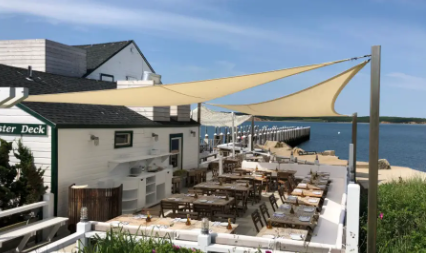
You smell the salt before you see the water. Rounding the bend on Tuthill Road, the first thing that hits you is brine mixed with woodsmoke, then the glint of Fort Pond Bay stretching toward Long Island Sound. Subsequently, you notice the yachts. A dozen of them, at least, anchored just offshore or tied to the dock, their owners already three glasses into the rosé. This is Duryea’s in summer—a place where billionaires queue for lobster rolls alongside surfers fresh from Ditch Plains. However, what most visitors don’t realize is that they’re standing on the last remaining piece of a vanished world.
The Origin Story: From Fishing Village to Seafood Dynasty
Captain Tuthill’s Ice House
The story begins in 1888, when Captain Edwin Baker Tuthill built a fishing shack and ice house on the shores of Fort Pond Bay. At the time, the bay was home to Montauk’s original fishing village—a scrappy community of Nova Scotian and Scandinavian fishermen who had migrated south following the menhaden boats. Consequently, the area hummed with commercial activity. Pound nets dotted the water, and fish were stored alive in submerged pens until market prices looked favorable.
Meanwhile, the Long Island Rail Road had extended its tracks to the waterfront, and Tuthill positioned himself perfectly. He ran a local fish business, shipping catches to Manhattan via the morning trains. Additionally, his operation sold provisions, paint, rope, and gasoline to the working fleet. For decades, this was simply how Montauk worked.
Perry Duryea Sr. Enters the Picture
In the late 1920s, a young businessman named Perry Belmont Duryea Sr. bought into Tuthill’s operation. The Duryeas would transform a modest fish business into a seafood empire—and in the process, become Montauk’s most influential family. Furthermore, Duryea Sr. had political ambitions. He eventually served as East Hampton Town Supervisor and later as a New York State Senator.
By the early 1930s, the business had rebranded as Perry B. Duryea & Son, focusing primarily on seafood distribution and ice manufacturing. The operation grew steadily, though the family couldn’t have anticipated what September 1938 would bring.
The Crisis: When a Hurricane Erased a Village
September 21, 1938
The Great Hurricane of 1938 arrived without warning. At 4 p.m., winds exceeding 100 miles per hour slammed into eastern Long Island. Fort Pond Bay surged into the fishing village, wiping out homes, boats, and businesses in a matter of hours. Consequently, residents fled to higher ground at the Montauk Manor, watching from the hilltop as their community disappeared.
The destruction was nearly total. Twenty-six houses and fourteen boats ended up stacked on top of each other. The village’s post office, restaurants, and school were demolished. However, one structure survived virtually intact: Duryea’s ice house. A photograph from the archives shows Perry Duryea Sr. standing amid the wreckage with Robert Moses, surveying the damage. The Duryea buildings would become the only remnants of the original fishing village.
Rebuilding From the Wreckage
The fishing village was never rebuilt. Instead, Montauk’s commercial center relocated to the south side of town, and the fishing fleet gradually moved to Lake Montauk harbor. Nevertheless, the Duryeas stayed put. Their Fort Pond Bay location—now isolated rather than central—became something different: a destination.
The Transformation: From Fish Market to Political Dynasty
Perry Duryea Jr. Returns From War
When Perry Duryea Jr. came home from World War II in 1948, he rejoined the family business with fresh ambitions. A Navy pilot who had attained the rank of Lieutenant Commander, he brought military precision to seafood distribution. Moreover, he spotted an opportunity that would change everything.
Duryea Jr. established connections with lobster dealers in Maine and Nova Scotia. He imported lobsters to Montauk, warehoused them at the family facility, then shipped them to supermarkets, restaurants, and fish markets across the metropolitan area. Consequently, a regional fish business became a major wholesale operation. The Duryeas were no longer just catching and selling—they were controlling supply chains.
The Speaker of the Assembly
Politics ran in the Duryea blood. Perry Duryea Jr. was elected to the New York State Assembly in 1960 and rose to become its Speaker from 1969 to 1973. Remarkably, he remains the last Republican ever to hold that position. Furthermore, he ran for Governor of New York in 1978, losing to Hugh Carey but cementing the family’s legendary status on Long Island.
Throughout his political career, Duryea Jr. fought against overdevelopment of eastern Long Island. In 1967, he successfully blocked plans to convert the Grumman plant in Calverton into metropolitan New York’s fourth major airport. Additionally, he founded the Montauk Airport in the 1950s, flying his private plane to Albany when the legislature was in session. The Montauk post office now bears his name.
What Made Duryea’s Iconic: The Original Experience
The BYOB Lobster Shack
For decades, Duryea’s operated as the quintessential no-frills seafood experience. You ordered at the window. You waited for your name to be called. You carried paper plates with plastic utensils to weathered picnic tables overlooking the bay. Furthermore, you brought your own wine—this was BYOB country, and everyone knew it.
Locals packed coolers after beach days at Hither Hills, then drove to Duryea’s for sunset lobster dinners. The prices were reasonable. The view was priceless. Meanwhile, the Duryea family—three generations of them—kept the operation running through hurricanes, recessions, and the slow transformation of Montauk from fishing village to summer colony.
Perry “Chip” Duryea III Takes the Helm
Perry “Chip” Duryea III grew up on Fort Pond Bay. He learned to surf the outer bars of Ditch Plains alone in the 1960s, becoming one of Montauk’s original wave riders. Subsequently, he took over the family business, serving as a director of the Montauk Chamber of Commerce and Fighting Chance, a cancer research center in Sag Harbor.
By 2014, however, Chip was ready to retire. He sold the property to Marc Rowan, co-founder of Apollo Global Management, for $6.3 million. The sale represented more than a real estate transaction—it marked the end of an 85-year family tradition.
The New Era: Billionaire Aesthetics Meet Working Waterfront
Marc Rowan’s Accidental Restaurant Empire
Marc Rowan didn’t set out to become a restaurateur. “I got into the restaurant business by accident,” he told Fortune magazine. “It all started because I like to build things.” Nevertheless, the Apollo CEO—whose net worth exceeds $3 billion—has transformed Duryea’s into something its founders never imagined.
The renovation began around 2016 and sparked years of legal battles with East Hampton Town over zoning, restaurant use, and dock expansion. However, the aesthetic results are undeniable. The weathered picnic tables gave way to elegant wooden seating with overhead sails. The BYOB policy disappeared, replaced by an extensive wine list featuring $795 bottles of Dom Pérignon.
The Lobster Deck Experience Today
Duryea’s now evokes the French Riviera more than the working waterfront. The dock accommodates yachts up to 150 feet, and roughly half the summer clientele arrives by boat. Consequently, it’s perfectly normal to spot Beyoncé and Jay-Z pulling up while you nibble crudités from artisan wooden bowls. Jennifer Lopez, Gwyneth Paltrow, and countless hedge fund managers have made this their summer canteen.
The ordering system, remarkably, hasn’t changed. You still fill out a clipboard menu at your table, walk it to the window, and pay before eating—tip included. This holdover from the BYOB era strikes some visitors as incongruous with $97 salads, but regulars understand: the tradition matters.
The Signature Dish: Anatomy of a Lobster Cobb
Why Everyone Orders the Same Thing
Duryea’s Lobster Cobb Salad has achieved cult status. At approximately $95 and designed to share among three or four people, it represents the restaurant’s philosophy: elevated ingredients, unpretentious presentation, serious price tag. Executive Chef Philippe Corbet describes it as “the perfect Montauk summer lobster dish.”
The construction follows classic Cobb architecture: baby gem lettuce tossed with tarragon dressing, topped with fresh lobster salad, diced avocado, hard-boiled eggs, crispy bacon, cherry tomatoes, and sharp cheddar shavings. That last element—cheddar rather than traditional blue cheese—is a deliberate choice. The cheese provides saltiness without competing with the lobster’s sweetness.
The Insider’s Order
Beyond the famous Cobb, the menu reads like a pescatarian’s dream. The whole grilled octopus arrives over crushed potatoes with kalamata olives and Romesco sauce. The stuffed clams combine chorizo, panko, and red bell pepper in a satisfying crunch. Furthermore, the lobster roll—pure meat on a grilled bun with sweet potato chips—remains one of the East End’s finest.
The Insider’s Take: Ask for two toasted buns alongside your Lobster Cobb. Stuff the salad into the bread, and you’ve essentially created two lobster rolls for the price of one shared appetizer. Additionally, arrive before 5 p.m. on weekdays for the shortest wait times.
The Sunset Cottages: Duryea’s Next Chapter
$2,000 Nights on Fort Pond Bay
In 2025, Duryea’s expanded beyond dining with the opening of Sunset Cottages. Four minimalist bungalows perch on a bluff above the bay, featuring cedar shingles, teak decks, outdoor showers, hot tubs, and fire pits. Rates hover around $2,000 per night, positioning them as alternatives to the increasingly regulated private rental market.
Cottage guests receive priority seating at the restaurant—a significant advantage when the Lobster Deck operates walk-in only throughout summer. Breakfast hampers appear at your door as if by magic. Lobster rolls can be delivered mid-afternoon. Furthermore, complimentary electric bikes and paddleboards ensure you never actually need to leave the property.
This means, you take one article, and you use the article distribution system. It will generate thousands of unique versions of your article, and publish those unique articles to hundreds of websites that are related to your niche.
Take a look at our comprehensive guide to the best and most popular information ebooks and products available today on Detoxing, Colon Cleansing, Weight Loss and Dating and Romance. They are all in one spot, easy to find and compere to make a quick selection for the product that best fits your needs or wants.
So browse through a category and make your preferred selection and come back here to read more choice articles and get a few more helpful tips on ways to help your enhancement.
As an Amazon Associate I earn from qualifying purchases. “saubiosaubiosuccess.com is a participant in third party affiliate and advertising programs; The Amazon Services LLC Associates Program, Awin network, and other affiliate advertising programs are designed to provide a means for sites to earn advertising fees and commissions by advertising and linking to products on other sites and on Amazon.com. Amazon and the Amazon logo are trademarks of Amazon.com, Inc, or its affiliates.”
We use anonymous cookies and various 3rd-party services to optimise and to offer you a better, more personalised, browsing experience with advanced accessibility enhancements.
Dismiss
Always active
The technical storage or access is strictly necessary for the legitimate purpose of enabling the use of a specific service explicitly requested by the subscriber or user, or for the sole purpose of carrying out the transmission of a communication over an electronic communications network.
Preferences
The technical storage or access is necessary for the legitimate purpose of storing preferences that are not requested by the subscriber or user.
Statistics
The technical storage or access that is used exclusively for statistical purposes.The technical storage or access that is used exclusively for anonymous statistical purposes. Without a subpoena, voluntary compliance on the part of your Internet Service Provider, or additional records from a third party, information stored or retrieved for this purpose alone cannot usually be used to identify you.
Marketing
The technical storage or access is required to create user profiles to send advertising, or to track the user on a website or across several websites for similar marketing purposes.