The Commerce Department’s Bureau of Economic Analysis released its personal income and outlays report Friday morning. Among the headline numbers was April’s 12.9% increase in disposable personal income along with a 13.6% month-over-month decrease in consumer spending.
Talk about good news mixed in with the bad. The income number’s jarring to say the least. How did household receipts actually increase as so many jobs were lost?
Dig down a bit and it becomes clear. Yes, personal income rose nearly $2 trillion in April, but employee compensation fell by more than $870 billion. So where did the all that new pocket money come from?
The government. Transfers to individuals nearly doubled in April to $6.35 trillion.
That was (arguably) the good news. And the bad news?
Personal consumption expenditures (PCE) fell nearly $1.9 trillion last month. More than $741 billion in goods purchasing evaporated. Spending for services fell by nearly $1.2 trillion.
Here’s the big picture: The temporary boost in personal income, combined with depressed spending, now makes us a nation of savers. Our savings rate—normally about 8% of disposable income—ballooned to a whopping 33% in April.
And why’s that bad? To turn those government transfers into true stimulus, those savings need to flow back into the economy. Folks have to start spending again. Now, it’s true the hiatus on services spending forced by coronavirus lockdowns is ending, to some degree or another. People are now going out to dine and to get haircuts. Spikes in infection and hospitalizations rates, however, could threaten the recovery and prompt another round of business closures. The recovery is tenuous at best.
There’s more worrying news below the BEA’s headline numbers. It’s the core PCE number, the Federal Reserve’s favorite deflator. Core PCE measures the prices paid by consumers for goods and services excluding the volatile costs of food and energy. The Fed believes core PCE most accurately reveals underlying inflation trends.
For many years, the Fed’s sweet spot for core PCE has been a 2% year-over-year increase. That’s a target that’s often missed, though. The last time the Fed threaded that economic needle was 2012 and then just for 4 months. Since then, core PCE inflation’s been averaging 1.61% annually. In April, however, the rates slipped below 1% for the first time in 11 years. It’s a real rarity for the inflation rate to get that low: it’s happened just five times since the annual rate’s first calculation in 1960.
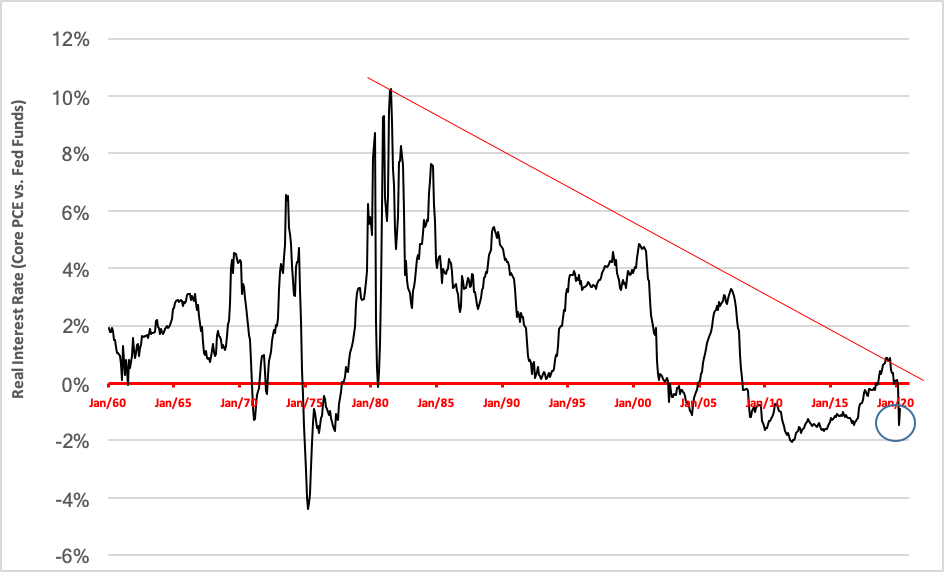
Historical novelty aside, the drop in the PCE inflation rate has further significance to consumers and investors. It’s boosted real yields, even as the Fed ratcheted down overnight lending rates. Not by much, mind you. The real Fed Funds rate is still underwater at -0.91% but that’s 54 basis points better than it was in March (see the chart below).
Real Interest Rates
The problem with rising rates? In reality (no pun intended), it’s a negation of the Fed’s intended accommodation. Most particularly, rising real rates encourage saving rather than spending and investing. That’s definitely not stimulative.
We may be overthinking this if the current disinflationary excursion is short-lived. After all, the longest stretch of sub-1% PCE performance has been just four months.
But these are times like no other. The Fed’s got to be watching this with a fair amount of trepidation. If the inflation trend persists, the central bank may have to look beyond traditional accommodation. What form monetary policy takes in the future will, in large part, depend on the fiscal policy adopted by the administration and Congress.
And that, in an election year, is anybody’s guess.
Brad Zigler is WealthManagement's Alternative Investments Editor. Previously, he was the head of Marketing, Research and Education for the Pacific Exchange's (now NYSE Arca) option market and the iShares complex of exchange traded funds.
This means, you take one article, and you use the article distribution system. It will generate thousands of unique versions of your article, and publish those unique articles to hundreds of websites that are related to your niche.
Take a look at our comprehensive guide to the best and most popular information ebooks and products available today on Detoxing, Colon Cleansing, Weight Loss and Dating and Romance. They are all in one spot, easy to find and compere to make a quick selection for the product that best fits your needs or wants.
So browse through a category and make your preferred selection and come back here to read more choice articles and get a few more helpful tips on ways to help your enhancement.
As an Amazon Associate I earn from qualifying purchases. “saubiosaubiosuccess.com is a participant in third party affiliate and advertising programs; The Amazon Services LLC Associates Program, Awin network, and other affiliate advertising programs are designed to provide a means for sites to earn advertising fees and commissions by advertising and linking to products on other sites and on Amazon.com. Amazon and the Amazon logo are trademarks of Amazon.com, Inc, or its affiliates.”
We use anonymous cookies and various 3rd-party services to optimise and to offer you a better, more personalised, browsing experience with advanced accessibility enhancements.
Dismiss
Always active
The technical storage or access is strictly necessary for the legitimate purpose of enabling the use of a specific service explicitly requested by the subscriber or user, or for the sole purpose of carrying out the transmission of a communication over an electronic communications network.
Preferences
The technical storage or access is necessary for the legitimate purpose of storing preferences that are not requested by the subscriber or user.
Statistics
The technical storage or access that is used exclusively for statistical purposes.The technical storage or access that is used exclusively for anonymous statistical purposes. Without a subpoena, voluntary compliance on the part of your Internet Service Provider, or additional records from a third party, information stored or retrieved for this purpose alone cannot usually be used to identify you.
Marketing
The technical storage or access is required to create user profiles to send advertising, or to track the user on a website or across several websites for similar marketing purposes.